

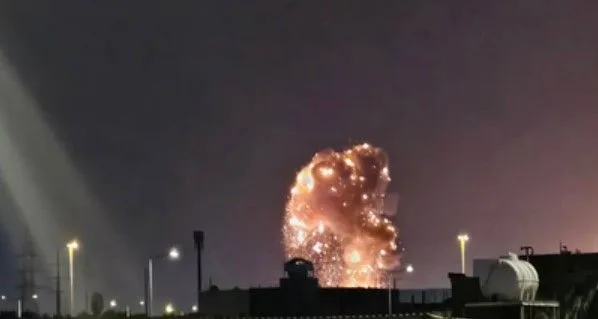
The United States escalated its response to recent Iranian aggression by conducting targeted airstrikes on more than 80 Iranian military sites and simultaneously revoking a Treasury licence that permitted limited Iranian oil exports. These actions come after Iran allegedly attacked three commercial ships passing through the strategic Strait of Hormuz, a vital artery for global maritime trade.
American forces struck a wide range of Iranian assets, including air defense systems, command and control centers, coastal radar installations, anti-ship missile sites, and more than 60 small boats operated by the Islamic Revolutionary Guard Corps near the waterway. The strikes aimed to weaken Iran’s capacity to carry out further hostile actions against international shipping.

The Pentagon identified the targeted vessels as the Marshall Islands-flagged M/T Al Rekayyat, the Saudi Arabia-flagged M/T Wedyan, and the Liberian-flagged M/T Cyprus Prosperity, all reportedly attacked by Iran. CENTCOM described these attacks as a blatant breach of the ceasefire agreement recently established with Tehran, asserting that Iran’s actions threaten freedom of navigation and international commerce in one of the world’s busiest shipping corridors.
Alongside the military campaign, the US Treasury Department withdrew General License X, which had temporarily allowed the production, delivery, and sale of Iranian crude oil and petrochemical products under the ceasefire terms. It replaced it with General License X1, which restricts new transactions and shipments after July 7 and only permits a limited wind-down period for previously authorized deals through July 17.
This coordinated military and economic pressure reflects the US government’s strategy to hold Iran accountable for violations of the ceasefire and to deter further attacks. CENTCOM confirmed that forces remain ready to take additional measures if Iran continues to disregard the agreement and disrupt maritime security in the region.