

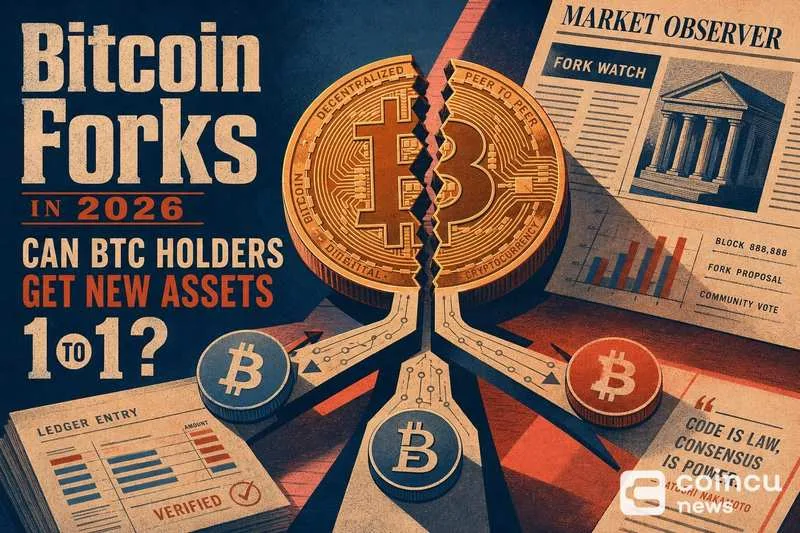
Bitcoin holders face potential fork events in 2026, with two separate proposals circulating that promise to issue new tokens at a 1:1 ratio based on current BTC holdings. However, neither fork has launched or announced critical details such as official snapshot dates or confirmed support from major exchanges, leaving much of the community cautious about the actual materialization of these forks.
One of the proposed forks involves BIP-110, a Bitcoin Improvement Proposal discussed within developer circles as a method to enable sidechains via a soft fork upgrade path. This approach is a technical enhancement intended to increase Bitcoin’s functionality without changing the core asset’s distribution. The second proposal, put forward by developer Paul Sztorc, involves a hard fork aimed at redistributing coins allegedly tied to Satoshi Nakamoto’s early wallets. This idea has stirred controversy and has been widely criticized by the Bitcoin community for potentially expropriating dormant coins without owners’ consent.

While both fork concepts share the premise of issuing new assets to BTC holders at a 1:1 ratio, their motivations and mechanisms differ significantly. BIP-110 is registered in the official Bitcoin BIPs repository and pursues a standards-track improvement, whereas Sztorc’s fork is a standalone effort with far-reaching implications and less community acceptance. At this stage, neither has generated a new blockchain or tokens, and no blockchain snapshot points—used to record owners’ balances for the fork—have been revealed.
For holders, understanding the conditions behind a 1:1 distribution is crucial. Historically, forks like Bitcoin Cash (2017) and Bitcoin SV (2018) granted holders new tokens proportional to their BTC balances at a defined block height snapshot. This automatic allocation occurs only for holders controlling their private keys at the snapshot time. In contrast, individuals holding Bitcoin on exchanges depend entirely on those platforms’ willingness to credit the new assets. Exchange support has varied widely in previous forks, with some recognizing forked tokens promptly and others refusing or delaying user distributions.
Additionally, fork announcements often attract fraudulent schemes, including fake claiming websites and phishing attempts. Users should exercise caution and avoid engaging with unofficial portals or suspicious offers claiming to facilitate fork asset claims.