

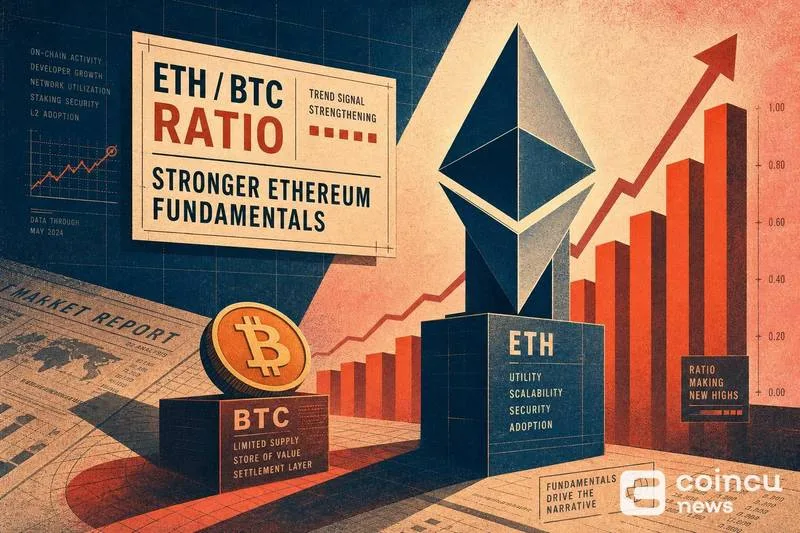
The upward shift in the ETH/BTC ratio signals growing market confidence in Ethereum’s future prospects relative to Bitcoin. This ratio measures how much Bitcoin one Ether can buy, serving as a gauge of relative performance rather than absolute price movements. When the ETH/BTC ratio climbs, it indicates that Ethereum is outperforming Bitcoin regardless of their individual dollar price fluctuations.
According to Tom Lee, co-founder of Fundstrat Global Advisors, the rising ratio is a reflection of investor expectations for enhanced Ethereum fundamentals rather than confirmation of changes already realized. This perspective treats the ratio as a forward-looking indicator, suggesting that capital flows are rotating toward Ethereum in anticipation of upcoming positive developments.

Market participants often monitor this ratio as an indicator of shifting sentiment between the two largest cryptocurrencies. A sustained increase typically points to perceptions of stronger near-term catalysts or better growth potential on the Ethereum network, which may include technical advancements, higher on-chain activity, or increased institutional interest.
Ethereum fundamentals encompass a wide range of factors. Key measures include network usage statistics such as transaction volume and active wallet addresses, fee revenue dynamics, and changes in the net supply of Ether. Developer engagement, reflected by smart contract deployments, also forms a core part of this assessment.
Beyond technical metrics, the amount of capital locked in Ethereum-based decentralized finance (DeFi) protocols and the level of Ether staking activity reveal long-term holder conviction and confidence in the network’s sustainability. Institutional exposure, including corporate and fund investment in Ethereum, adds another layer impacting fundamentals.
Lee’s interpretation aligns with Fundstrat’s broader methodology, which commonly uses relative strength indicators in crypto to assess market sentiment. By focusing on the ETH/BTC ratio, analysts aim to capture consensus expectations rather than purely tracking price trends, providing deeper insight into how investors value Ethereum’s evolving ecosystem compared to Bitcoin.