

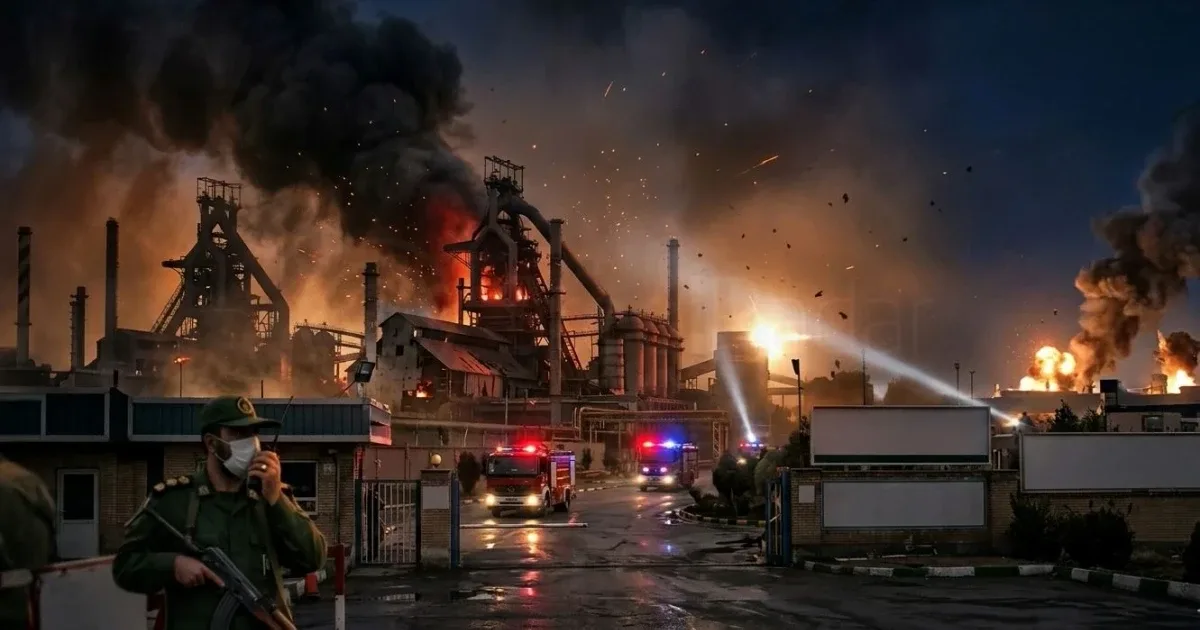
Israeli airstrikes severely disrupted two of Iran’s largest steel producers by damaging essential storage and power systems, raising alarms about the economic fallout for the country’s steel sector. The assaults targeted Mobarakeh Steel in Isfahan and Khuzestan Steel in Ahvaz, key facilities responsible for a significant share of Iran’s steel production.
These strikes came amid a broader conflict between Israel and Iran, during which multiple strategic and civilian sectors were hit. Israeli security sources suggested the attacks could cost Iran billions of dollars and potentially cripple its steel industry, which already faces challenges from international sanctions and ongoing regional tensions.

According to satellite images and detailed analyses, the strikes hit critical bottlenecks in production that disrupted output at both plants. Iran’s steel industry is a major economic driver, supporting about 1.2 million jobs along its supply chain and representing roughly 5% of the country’s GDP. Projections cited by the World Steel Association place Iran’s crude steel output at nearly 32 million tons for 2025, while Mobarakeh Steel alone reportedly generated hundreds of millions in export revenue.
The targeting of steel plants sparked renewed scrutiny under international humanitarian law, which permits attacks on civilian infrastructure only if it actively supports military operations and if its destruction offers a concrete military advantage. Critics argue these steel facilities primarily serve civilian economic functions, complicating the legal justification presented by Israeli officials who categorize them as dual-use assets.
The strikes were part of a wider military campaign lasting from mid-June to late June 2025, during which Israel also attacked Iran’s nuclear, missile, and energy installations before a ceasefire was declared. The conflict led to significant casualties, with over a thousand deaths reported in Iran and several dozen in Israel.
Following the attacks, Iranian officials vowed harsh retaliation, signaling potential responses targeting Israeli industrial infrastructure and sites in the Gulf region. The steel strikes thus not only affected Iran’s industrial capacity but also intensified tensions in an already volatile regional landscape.