

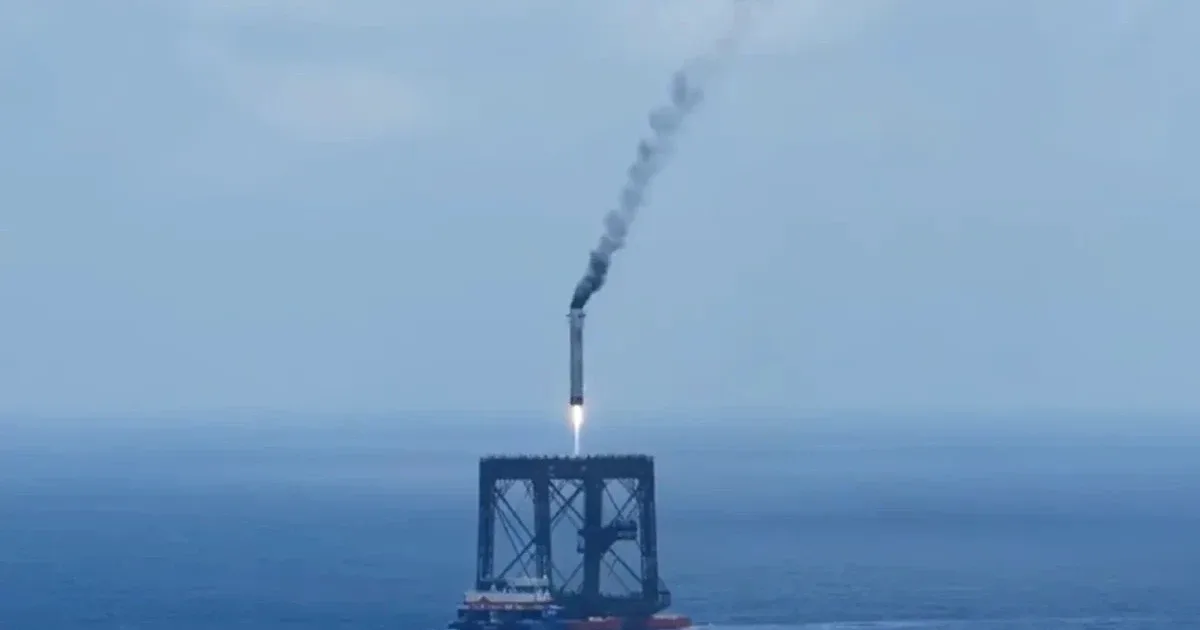
China has completed its first successful at-sea recovery of a reusable rocket booster, demonstrating significant progress in lowering launch costs and increasing orbital launch frequency. The Long March 10B rocket launched from Hainan Island, deployed a satellite into orbit, and landed its first stage on a platform in the South China Sea, marking a key step toward routine, cost-effective space operations.
The China National Space Administration described this event as the world’s first controlled retrieval of a carrier rocket’s first stage using a net-based offshore platform. Unlike the US SpaceX Falcon 9 rockets, which land vertically on legs, Long March 10B’s booster used four landing hooks in its recovery, a novel approach in the reusable launch sector. The booster returned approximately six minutes after separation from the upper stage.

This breakthrough underscores China’s ambition to move away from one-time launches toward a system capable of rapid and scalable orbital missions. The Long March 10B can carry at least 16 metric tons to low Earth orbit, supporting China’s expanding satellite constellations including military, navigation, and internet service applications. This effort complements China's broader space ambitions, which feature continuous crew rotations aboard its Tiangong space station, lunar sample returns from Chang’e-6, and deep space probes like Tianwen-2.
Chinese aerospace companies reacted positively to the launch, reflecting the high commercial stakes tied to reusable rocketry. China Aerospace Science and Technology Corporation plans to conduct around 100 orbital launches this year, signaling a shift toward using launch capacity as an industrial asset rather than solely for prestige. This enhanced launch cadence forms a core part of Beijing’s drive to establish a comprehensive space infrastructure by the end of the decade.
Meanwhile, NASA continues to focus on its Moon-to-Mars exploration strategy, recently adding lunar surface habitat and cargo lander components to its plans. However, analysts highlight that the current space competition involves more than exploration prestige; it hinges on military capabilities, industrial strategy, and geopolitical alliances far beyond the Cold War-era space race.