

Oil markets reacted strongly to a new round of conflict between the United States and Iran, with Brent crude climbing significantly before easing slightly but maintaining substantial gains. The escalation followed US airstrikes targeting Iran in response to an Iranian attack on a container ship in the strategic Strait of Hormuz, which resulted in a fire and a missing crew member. Iran promptly retaliated by striking across various Middle Eastern locations, deepening concerns about stability in the energy-rich region.
In premarket trading, energy sector giants such as ExxonMobil, ConocoPhillips, and Chevron saw their shares rise by about 1%, driven by worries over disrupted oil supplies. Brent crude surged nearly 5% at its peak, settling up over 3% midday in Europe at $77.72 per barrel. The US benchmark crude also increased by roughly 3.5%, reaching $72.92 per barrel. These price movements come after oil prices had somewhat stabilized following a temporary agreement that enabled the resumption of shipping through the Strait of Hormuz.

Meanwhile, US stock futures presented a mixed picture. Futures for the S&P 500 dropped 0.3%, Nasdaq futures fell 0.8%, and Dow Jones futures remained largely flat. Semiconductor and memory chip makers, including SanDisk, Western Digital, and Micron, pushed indexes lower with premarket declines near 5%. In contrast, energy stocks pushed upward, reflecting investor focus on the geopolitical risks potentially impacting global crude flows.
Traders also face mounting uncertainty about how ongoing conflict might influence inflation and interest rate policies worldwide. Rising oil prices elevate inflation concerns, which in turn reinforce expectations for continued hikes in interest rates by the Federal Reserve and other central banks. These higher rates aim to curb inflation but also dampen economic growth and can negatively affect investment valuations across multiple sectors.
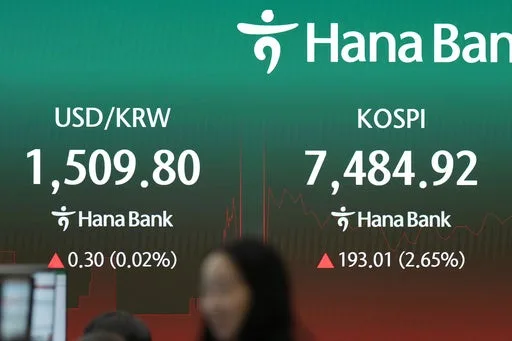
Global equity markets traced varied trajectories amid these tensions. European indexes showed resilience, with Germany’s DAX and Paris’s CAC 40 each gaining modestly, while Britain’s FTSE 100 held steady. Asian markets exhibited more volatility: Japan’s Nikkei dropped nearly 2%, and South Korea’s Kospi fell sharply by 9%, marking its lowest point since early May. Notably, South Korean memory chip companies SK Hynix and Samsung Electronics suffered steep declines of over 10%, reversing recent gains. Meanwhile, Hong Kong’s Hang Seng index edged higher, and China’s Shanghai Composite decreased by just over 2%. Australia’s S&P/ASX 200 remained nearly unchanged for the day.
Investors are also bracing for an upcoming series of earnings reports from leading US banks, including Bank of America, Citigroup, JPMorgan Chase, Goldman Sachs, and Wells Fargo, which are expected to provide further insights into the economic impact of geopolitical stress and inflationary pressures.