

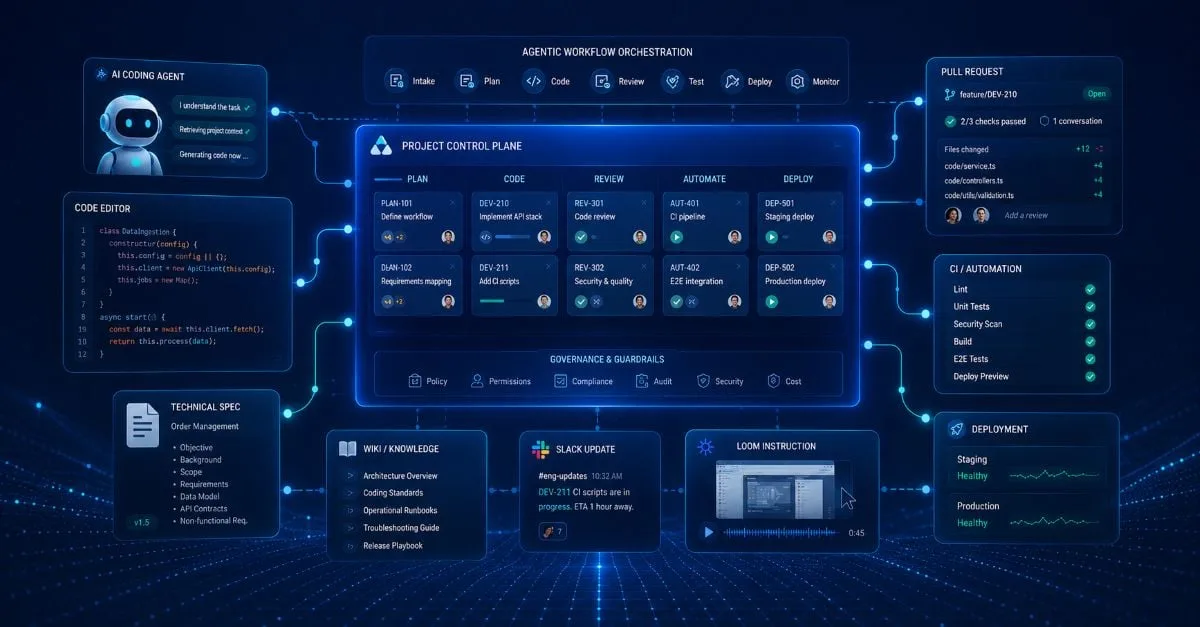
Atlassian recently enhanced Jira by embedding AI capabilities that allow teams to delegate technical tasks to AI coding agents, turning project tickets into pull requests ready for developer review. This move positions Jira not just as a project management tool but as a centralized hub for managing agent-driven engineering workflows.
The update connects Jira with prominent AI tools, including Claude Code from Anthropic, Cursor, and GitHub Copilot, with future support planned for OpenAI’s Codex. These integrations enable developers to embed AI assistants directly into their workflows, reducing manual overhead and accelerating delivery cycles. Additionally, Atlassian introduced the DX AI cost management report, helping teams consolidate spending and token usage for these AI tools alongside Jira project data.
One key feature is the Jira Coding Agent, now included in all paid plans, which leverages Jira’s contextual information to transform task tickets into review-ready code pull requests without requiring local development setup. This streamlines the handoff between AI and developers, who can focus on reviewing and refining AI-generated code.
Jira Planner also received an upgrade, able to generate structured technical specifications by pulling information from codebases, Jira tasks, and Confluence documentation. These specs can then guide AI or human developers in building applications, improving the alignment between planning and execution stages.
Further integration improvements include new interfaces between the Teamwork Graph CLI and Jira, as well as automation rules that allow coding agents to handle various business processes. This enables background routing of bug fixes or updates with engineers alerted only when reviews are needed, enhancing efficiency.
Atlassian introduced an Agentic Engineering project template and setup wizard designed to launch agent-enabled projects quickly, along with tighter Slack integration to facilitate team communication. In tandem, Loom—a video recording and screen capture tool—has been upgraded to produce detailed, AI-readable instructions from user interactions and voice commands. These instructions can be converted into actionable Jira work items for AI agents, simplifying task delegation.
The head of engineering for DevAI at Atlassian highlighted that these innovations transform Jira into a platform equipped to handle complex agentic workflows. By providing rich contextual data, Jira helps AI agents automate more reliably while optimizing the use of computational tokens involved in task completion.